
Yes, Greek Mythology Also Had Feminists
- Human Central
- Mar 15, 2022
- 6 min read
Updated: Mar 17, 2022
By: Koralynn Kennedy
Ever since the release of the Percy Jackson books, today's generations are becoming increasingly interested in Greek Mythology, especially the female figures. While there are many different interpretations of the myths, there is one idea that translates throughout all perceptions: Greek goddesses are forces to be reckoned with. Throughout history, Greek goddesses have been worshipped far and wide by all sorts of people, and many other religions have similar figures in their own mythology, such as Egyptian polytheism and the very closely related Roman polytheistic religion.
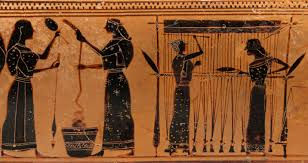
Detail from a Terracotta lekythos, showing two women spinning wool into yarn and two women working at an upright loom, c.550–530 BC. Metropolitan Museum of Art.
In all monotheistic religions, women play a major role in some kind of way, whether they play the "Wise Woman" that helps the hero on his quest, a female figure who is there to add onto the hero's story line, or even as a villain. However, in polytheistic religions, Greek mythology specifically, the female characters contain their own story lines. They are strong, they have their own identities that don't just describe how they relate to their male counterparts, and some stories even encourage women to own their sexuality, a very taboo subject across many other religions. These ideas are very similar to ideas supported by modern feminism, the ideology of women being equal to men. Ideas of modern feminism
are present in Greek mythology by supporting the uplifting of women’s success, independence, and sexuality.
Many people have misconceptions about women in Greek mythology. Instead of seeing Aphrodite as a strong woman who embraces her sexuality, they see a woman who is nothing but an attractive face with a flirtatious attitude. Hera, wife of Hades, is seen as crazy and controlling when she stands up to her husband for cheating on her. Even Medusa is seen as an evil monster when her curse is a method of self-protection. These misconceptions have created widespread misinterpretation of the Greek Goddesses.
Aphrodite is the goddess of love, beauty, and procreation (Cartwright). Compared to the other female role models of Greek mythology, many don’t see Aphrodite as a feminist icon. In actuality, Aphrodite represents one of the biggest ideologies of modern feminism: embracing your sexuality (Velez). In a time where a stigma surrounded women’s sexuality, Aphrodite should have been seen as a radical, but she wasn’t. Aphrodite is one of the earliest known characters of religion and folklore to be proud of her sexuality and wasn’t shamed for it. In fact, Aphrodite was one of the most worshipped of the gods, with shrines and temples all over ancient Greece (Zelazko). Even though Aphrodite was very passionate about her sexual relations with others, she did not shame women for not wanting sex. In their book The Goddess Within: A Guide to the Eternal Myths That Shape Women’s Lives, Jennifer and Roger Woolger describe how Aphrodite was a goddess of love before anything, “Above all, Aphrodite
wants relationships to be loving, whether they be amicable, social, physical, or spiritual. Relationships where there is heart” (Miller). Because many women have been forced into marriage, been stuck in an abusive relationship, or are not able to love who they want to, Aphrodite’s encouragement of healthy relationships is one that has been embraced by the feminism movement. The story of Aphrodite is one of love, whether it involves sex or not, empowering women to engage in healthy relationships.
On the other end of the scale of sexuality is Artemis. Artemis, goddess of the hunt, is a vowed celibate who does not care for love at all. Her life’s purpose is her work as a huntress and never had a relationship or consorted with anyone (The National Herald). While Aphrodite is empowered by her sexuality, Artemis is empowered by her lack of it. The existence of both of these characters in Greek
mythology while both of them being seen as equals implies that neither is in the wrong for not being like the other. This also enforces a common feminist ideology: having the freedom to choose. Artemis was also very adamant on having a freedom of choice, which is evident in her tale with Actaeon. Actaeon was a hunting partner of Artemis, but when he tried to rape her, she transformed him into a stag. Actaeon, in stag form, was then hunted down and slaughtered by his own hounds (Kennedy). As Aphrodite stands for women being comfortable in their sexuality, Artemis stands for women being able to choose to not have one.

Badass Women of Greek Mythology: Giaquinto di Corrado Bottega, Medea, 1752, Hinton Ampner National Trust, Bramdean, England, UK. Art UK.
In the 1970’s and 1980’s, there was a major feminist movement involving women getting more positions of power in the workforce. During this time, more women were rejecting the “stay-at-home mom” trope and a new majority had begun to develop careers instead of families (Ely et Padavic). This rhetoric became synonymous with modern feminism by enforcing the ideology that women are allowed to have a purpose other than procreation. Athena and Artemis are perfect examples of this due to their success in their respective careers. Athena, goddess of wisdom, courage, and war (to name a few), was one of the most successful war strategists in Greek lore, even though it was a male-dominated field (McBride). Artemis is known to be the best hunter in Greek mythology, another example of a woman excelling in a male-dominated field (Kennedy). Even the god(dess) of success and victory, Nike, is a woman. Feminism supports women’s success in their careers and so do the Greek myths of Athena, Artemis, and Nike.
Finally leaving the age of female passiveness, feminism is encouraging women to stand up for themselves. A prime example of a woman who was never afraid to speak her mind was the Greek goddess Hera. Hera is the goddess of the gods and the heavens. Hera was one of the most feared among the gods, even by her husband, Zeus. This is due to the tale that whenever Zeus would have an
affair, Hera would ruin everyone in her path until she had gotten her revenge. Another goddess who was feared by the other gods, Persephone, goddess of the underworld, had people afraid to even speak her name. While both of these Goddesses represent standing up for yourself, and even better instance of
feminism, in this case, is the tale of Athena and Medusa.
Medusa was a very beautiful maiden, and Poseidon, god of the sea, desired her. He then raped her in Athena’s shrine. Athena, wildly upset by the rape, gave Medusa snakes for hair (Glennin). Many retellings of Medusa’s story paints a jealous Athena who cursed Medusa to punish her. Recent interpretations, however, write Medusa’s story as one of women sticking up for each other. Athena, in a world where women are expected to stay virgins and men have no consequences for taking virginities by force, was being watched by the gods when dealing with Medusa. She was, in fact, wildly upset by the rape, but because it was unjust, not because of jealousy. Giving Medusa snakes for hair and the ability to turn anyone into stone not only saves Athena from getting punished by the gods for not punishing Medusa, but it also gives Medusa a way to protect herself. Athena was protecting Medusa but had to hide it as a curse (Mingren). Suppressing rape culture is a major component of modern feminism, which is supported by both Artemis and Athena.
In conclusion, Greek mythology supports ideas of modern feminism by placing emphasis on women’s success, independence, and sexuality. Aphrodite teaches women it is okay to love yourself and love others, and Artemis teaches women it is okay to not want love at all. Athena and Artemis teach women that they are capable of succeeding, even in a male-dominated field. Hera and Persephone teach women that it is important to stand up for yourself, and Athena and Medusa teach women that it is important to stand up for and protect others. Greek mythology is full of role models for women, we just have to interpret their stories in the right way.
Works Cited :
“Aphrodite.” Edited by Alicja Zelazko, Encyclopædia Britannica, Encyclopædia Britannica, Inc., 24 Sept. 2020, www.britannica.com/topic/Aphrodite-Greek-mythology.
Cartwright, Mark. “Aphrodite.” Ancient History Encyclopedia, Ancient History Encyclopedia, 13 Mar. 2021, www.ancient.eu/Aphrodite/.
Ely, Robin J., and Irene Padavic. “What's Really Holding Women Back?” Harvard Business Review, Harvard Business School Publishing, 19 Feb. 2020,
hbr.org/2020/03/whats-really-holding-women-back.
“Female Figures in Greek Mythology – Finding Feminine Role Models in Surprising Places.” Los Angeles Times, Los Angeles Times, 29 Sept. 2019, highschool. latimes.com/chaminade-high-school/female-figures-in-greek-mythology-finding-feminine-role-models-in-surprising-places/.
Glennin, Madeleine. “Medusa in Ancient Greek Art.” Heilbrunn Timeline of Art History, New York: The Metropolitan Museum of Art, Mar. 2017, www. metmuseum.org/toah/hd/medu/hd_medu.htm.
Kennedy, Kit. “Artemis: Wonder Woman of the Ancient World.” Classical Wisdom Weekly, Classical Wisdom Limited, 14 Jan. 2020, classicalwisdom.com /mythology/artemis-wonder-woman-of-the-ancient-world/.
Lefkowitz, Mary R. Women in Greek Myth. Johns Hopkins Univ. Pr., 1986.
McBride, Lisa. “Athena Was a Feminist; Stereotypes Centuries Old.” Oklahoman.com, GateHouse Media, LLC, 18 July 1982, www.oklahoman.com/ article /1990366/athena-was-a-feminist-stereotypes-centuries-old.
Miller, Heidi. “Writing Aphrodite: Imagining a Rhetoric of Desire for a Feminist Writing Course.” The Journal of the Assembly for Expanded Perspectives on Learning, vol. 12, 2006, pp. 36–48. Winter 2006-2007,doi:https://trace. tennessee.edu/cgi/viewcontent.cgi?article=1139&context=jaepl.
Mingren, Wu. “The Real Story of Medusa: Protective Powers from a Snake-Haired Gorgon.” Ancient Origins, Ancient Origins, 21 Jan. 2021, www.ancient-origins. net/myths-legends-europe/legend-medusa-and-gorgons-002773.
Mostafa, Makarem. “The Role Of Women In The Greek Mythology.” Promediaz, 23 Jan. 2018, promediaz.com/en/role-women-greek-mythology/.
The National Herald. “5 Greek Goddesses That Inspired Women Before Wonder Woman.” The National Herald, The National Herald, 31 July 2017,
www.thenationalherald.com/archive_general_news_community/arthro/5_greek_goddesses_that_inspired_women_before_wonder_woman-21618/.
“Nike • Facts and Information on the Goddess Nike.” Greek Gods & Goddesses, Greek Gods and Goddesses 2010-2021, 9 Feb. 2017, greekgodsand goddesses.net/goddesses/nike/.
Rice, Kelly, et al. “Women in Greek Mythology.” A Journey into Greek Mythology, 18 Oct.2018, rampages.us/okayyoo/2016/10/18/women-in-greek-mythology/.
Velez, Author Devin. “A Modern Look at Venus: An Icon of Feminism and Pop Culture.”Network, 7 July 2018,eportfolios.roehampton.ac.uk/hsa020c132h /2018/06/30/a-modern-look-at-venus-an-icon-of-fe
minism-and-pop-culture/.


Comments